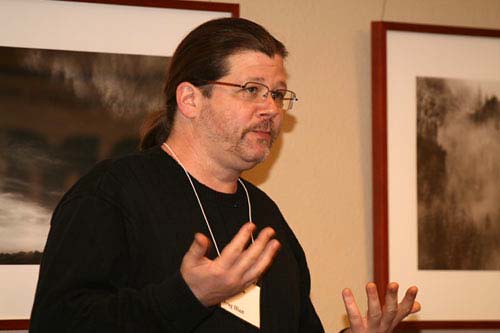
Frank Chopp doesn't want to blow his speakers. (Photo: www.leg.wa.gov)
Ever know someone who had a really hot car, but they were afraid to really drive it?
That's how Washington's Speaker of the House Frank Chopp rolls.
How about the guy who had the 300-watt stereo system, but would never crank it up because "I don't want to blow the speakers"?
That's how Frank Chopp gets down.
And that's exactly how Chopp was getting down when a bill to decriminalize marijuana possession died in the Washington Legislature last spring.
According to multiple, well-placed sources (both inside the Legislature and those observing), Chopp, through a lack of political will and leadership, is the legislator most responsible for the death of marijuana decrim in the last session. A reliable inside source, in a position to know, tells me Chopp doesn't want to force a "controversial" marijuana decrim vote by the entire Legislature, because he doesn't want to force fellow Democrats (in the majority) to vote on pot any time before the 2010 elections.
The dude has a commanding Democratic majority in the state legislature, yet seems eerily unwilling to actually use that power to achieve progressive goals. Is that due to the fact that he's practically a sponsored candidate of the far-right Building Industries Association of Washington (BIAW), which funded both of Dino Rossi's reactionary (and unsuccessful) campaigns for Governor? Maybe. Chopp has worked with the BIAW to oppose consumer protection legislation supported by his own party.
"This is democracy at its worst," State Senator Brian Weinstein (D-Mercer Island) told The Stranger in a 2007 interview. "Here is one guy who overruled 30 Democratic senators and the Democratic House Judiciary Committee. There's no point in doing the fact finding, holding eight hours of hearings, of doing the right thing, if a dictator can just pull the rug out from under you."
"Weinstein went as far as to say Chopp killed the bill because he was sucking up to the BIAW," The Stranger's Josh Feit reported. According to Weinstein, Chopp wanted the BIAW on his side come election time to protect the Democratic majority. "And," Weinstein added derisively, "not do anything with it." (Chopp claims the BIAW had nothing to do with his decision.)
 Democratic Rep. Brendan Williams (D-Olympia), who wore a defiant "No BIAW" pin to a Democratic holiday fundraising event in 2008, said he’s not running again because Chopp has neutered the Democratic agenda in Olympia by cozying up with the BIAW. Williams has been a major victim of Chopp’s alliance with the builders assocation: Two years in a row Williams’s homeowner bill of rights was killed at the last minute by Chopp. The BIAW was upset that homeowners would, my goodness, have the basic right to sue for faulty construction.
"Losing his majority" seems to be a deep and recurring fear for Chopp; it seems not to have occurred to the man that the reason he enjoys a big Democratic majority in the House is that maybe, just maybe, the voters support the Democratic agenda. His continual trumpeting of the "One Washington" theme sounds less like a yen for unity and more like a call for capitulation to conservatives. This is probably why Dominic Holden of Seattle alternative newspaper The Stranger has called Chopp a "feckless sissy."
The House Speaker has gone so far to appease the GOP that one prominent Demoractic State Senator, asked if Washington Attorney General Rob McKenna would be the Republican nominee for governor in 2012, replied, “Who knows? The GOP could run Chopp.”
Chopp's leadership style, or lack thereof, has been a growing source of controversy within progressive Democrats for some time now. Over and over, you see Chopp described as "the most powerful politician in the state," but you'd never guess it from his unwillingness to go out on a limb, to take a stand, to have a backbone.
This is frustrating for progressive Democratic voters who (over?)assume that having a liberal House Speaker like Chopp would result in more progressive advances. Granted, Chopp has passed the estate tax, collective bargaining for state employees, a housing trust fund, the highest minimum wage in the country, opportunity grants for college tuition, and other achievements.
But edge a little farther out the progressive limb and it doesn't take long to run into a laundry list of disappointments. Progressive wish-list items like environmental protections on Maury Island, payday-loan guidelines to protect low-income borrowers (which even Georgia has), ratcheting down the more than 400 lucrative tax loopholes handed out by the state to corporations... all unfulfilled promises, all due to Chopp's failure, despite wide party and voter support, to make it happen.
Labor unions, disappointed by Chopp's (and Gov. Chris Gregoire's) failure to bring the Workers Privacy Act (WPA) to a vote in the 2009 session, in an unprecedented move, declined to endorse any candidates this year. (The WPA supports First Amendment privacy rights of individual conscience, including opinions about politics, religion, unionization, and charitable giving. The WPA would have made sure that employees who resist any indoctrination of this kind by their employers would not be punished, and was unanimously approved by the state Democratic Party.)
Chopp, who grew up in Bremerton, likes to describe himself as a "Bremerton Democrat" (translation: "I'm almost like Norm Dicks. Besides, I don't smoke pot; I drink beer. Vote for me, please!"), presumably to distance himself from the "effete Seattle liberal" image that scares him so badly ("One Washington," remember?) Basing public policy on fear of what the conservative, largely rural, eastern Washington might think seems to be Chopp's mode of operation.
Chopp "repeatedly refused to provide any responses to citizens on the issues through the 2008 Political Courage Test when asked to do so by national leaders of the political parties, prominent members of the media, Project Vote Smart President Richard Kimball, and Project Vote Smart staff," according to Project Vote Smart. That would require, like, taking a stand, you know?
But it is perhaps telling that a few years ago Chopp, in the "Washington Gubernatorial Election 1996 National Political Awareness Test," wouldn't list marijuana decrim as a cause he supported:

Chart: Project Vote Smart
The 400 Dollar Man
Even Chopp's own constituents seem, well, unenthusiastic about him, at least when it comes to campaign donations.
In 2004, Chopp raised $91,585.80 for his reelection campaign -- but only an embarrassing $400 came from residents from his own district -- a total of three of them. The lion's share is from corporations, PACs and unions. Most of the rest is from individuals who live outside the district.
By way of contrast, Chopp's district mate, Ed Murray (who, unlike Chopp, was running essentially unopposed) got plenty of contributions from district residents.
Playing It Safe? Really?
The richly ironic thing is, Frank Chopp thinks he's playing it safe by not letting the Dems vote on marijuana decrim -- when, in fact, he's dangerously out of step with the people of Washington on this issue.
A recent poll shows a whopping 81 percent of Washington voters believe the state's pot laws are not working. Alison Holcomb, director of the ACLU of Washington's Drug Policy Project, says public opinion is firmly behind pot decrim.
Yet Chopp's timidity on the marijuana issue kept the bill (whose prime sponsor in the House was Rep. Dave Upthegrove of south King County) from moving forward. What, exactly, must we do to convince Chopp to actually lead, rather than dodge furtively about in the shadows like a spooked quail?
Marijuana Laws Cost Us, Big Time: At Least $177 Million Per Year (and counting)

Rep. Brendan Williams of Olympia, one of the decrim bill's co-sponsors, used the cost-saving argument, vainly hoping hidebound conservative legislators would be attracted by fiscal responsibility. "Do you choose to provide health care for x number of children, or fund criminalizing marijuana possession?", he reasonably asked, citing a cost analysis of marijuana arrests taken from Washington State Institute for Public Policy data showing, based on the number of arrests in 2007, Washington would save at least $7.5 million by decriminalizing pot.
Throw in the $170 million the state of Washington wastes each year enforcing its futile and outdated marijuana laws -- which have no impact on marijuana use, according to the most extensive study ever undertaken on marijuana arrests -- and pretty soon you're talking real money.
And what do Washington's citizens get for their $177 million a year? Well, marijuana arrests, lots of them: 16,473 in 2007 -- 90 percent (14,766) of which were for simple possession (which would be decriminalized under the bill in question). Marijuana arrests accounted for almost half (48%) of all drug arrests in Washington during 2007.
Remember: The state of Washington is dealing with a $9 billion shortfall this year, yet somehow, even while cutting vital educational services, parks, and health care, finds money to bust pot smokers.
But I guess a paltry few million here and there doesn't mean a lot to the man who supports a project as monstrously expensive as what has been dubbed the "Choppway" or "Choppaduct" to replace Seattle's aging Viaduct -- even though voters in Chopp's district rejected an "elevated rebuild" by a convincing 73 percent.
The decrim bill would reduce the penalty for possessing up to 40 grams of marijuana to a civil infraction, subject to a $100 fine. Under current state law in Washington, having even one joint is a misdemeanor punishable by up to 90 days in jail. (A similar measure passed by a 30-point margin in a Massachusetts voter initiative last year.)
The bill almost immediately hit a roadblock after being introduced in January 2009. Rep. Chris Hurst of Enumclaw (office telephone 360-786-7866), a former narcotics officer(!) who chairs the Public Safety and Emergency Preparedness Committee, refused to give the bill a hearing. Ex-cop Hurst claimed he actually "supports" decrim, but said Washington state "should not act ahead of the federal government."
In fact that has never -- even once -- been a problem in the 13 states, including even Mississippi, that have decriminalized. Besides, according to Rep. Roger Goodman (D-Kirkland), an attorney and former head of the King County Bar Association's Drug Policy Project, "Federal law clearly allows the states to prescribe their own penalties, whether civil or criminal."
In fact that has never -- even once -- been a problem in the 13 states, including even Mississippi, that have decriminalized. Besides, according to Rep. Roger Goodman (D-Kirkland), an attorney and former head of the King County Bar Association's Drug Policy Project, "Federal law clearly allows the states to prescribe their own penalties, whether civil or criminal."
Make no mistake about it: If House Speaker Frank Chopp had demonstrated a little leadership (or cojones) on this issue, he could have asked Hurst to pass the decrim bill out of committee. But he didn't... which brings us back to the case of the missing balls.
 Will Frank Chopp Ever Grow A Pair?
Not unless his constituents (that's you, the voters) insist upon it; growth isn't always easy or comfortable. But if you make opposing marijuana decrim more uncomfortable for Frank Chopp than supporting it, he'll come around. It's amazing how fast these things can sprout once they get some proper support. (No, I'm not suggesting you think of yourself as a jockstrap.)
Call or write Rep. Chopp's office (contact info at bottom) and let him know that you, like the majority of Washingtonians, support decriminalizing marijuana.
Sen. Jeanne Kohl-Welles, D- Seattle, has authored legislation making possession of 40 grams or less of marijuana a civil infraction rather than a misdemeanor. Though the bill didn't get far last session (thanks in large part to Frank Chopp), Sen. Kohl-Welles plans on once again pushing it hard when the Legislature gets to work in 2010.
A matching bill will once again be introduced in the State House, where it has considerable Democratic support. “It will definitely be debated,” said Rep. Mary Helen Roberts, D-Lynnwood, who supports decriminalizing marijuana use and co-sponsored the House bill last spring.
This legislation is getting talked about among lawmakers seeking ways of cutting costs in the face of a $2 billion hole in the current budget, according to the Everett Herald-Net.
We all owe a big thanks to the members of the State Senate Judiciary Committee (which passed it 5-3 last spring) who supported the bill. The members of the committee who voted to pass were prime sponsor Sen. Jeanne Kohl-Welles, Committee Chair Sen. Adam Kline, Committee Vice Chair Sen. Debbie Regala, and the eloquent, intelligent and articulate Sen. Rodney Tom, all Democrats; and Republican Sen. Bob McCaslin, who bravely crossed party lines to make this a bipartisan effort.
On the other hand, Sen. Jim Hargrove and Sen. Pam Roach, along with Sen. Mike Carrell (the three Senate committee members who voted against the bill), proved that they don't mind wasting millions of your tax dollars on futile, pointless and cruel marijuana enforcement. Vote these clowns out of office next chance you get.
Call Speaker Chopp's office and let him know you support marijuana decrim.
(Etiquette hint: it's probably best not to talk about the missing balls.)
Rep. Frank Chopp
P.O. Box 40600
Olympia, WA 98504-0600
(360) 786-7920
E-mail Representative Chopp
District/Position: 43/2 (Democrat)
Rep. Frank Chopp
P.O. Box 40600
Olympia, WA 98504-0600
(360) 786-7920
E-mail Representative Chopp
District/Position: 43/2 (Democrat)